
Last Updated: February 2026
This question haunts every new dropshipper. You are marking up products 2-3x their cost on AliExpress, and you’re terrified customers will discover your source, call you a scammer, and buy direct.
Here is the reality: Most consumers won't. And the ones who do were never your ideal customers anyway.
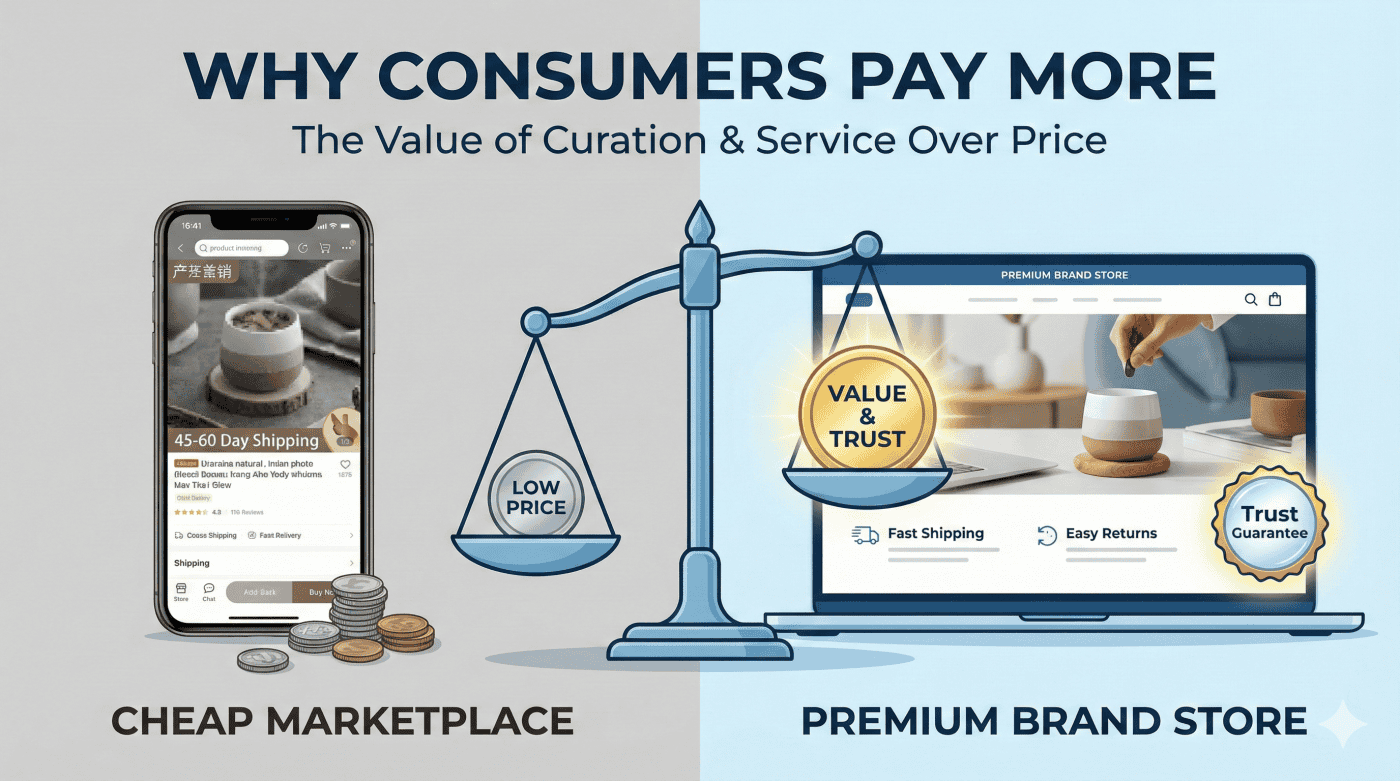
In 2026, the e-commerce landscape is dominated by convenience, curation, and trust. People don't buy “products”; they buy the certainty that the product will solve their problem.
TL;DR
- The “Amazon Effect”: Consumers are trained to pay for speed, easy returns, and curated selection—things AliExpress cannot offer.
- The Trust Gap: A professional store with clear policies and English support is worth the price premium.
- The “Curator's Fee”: You aren't just reselling; you are filtering out the 99% of junk products so your customer doesn't have to.
- The Reality Check: Only ~5% of AliExpress traffic comes from the US. It is simply not on the average shopper's radar.
Consumers buy from dropshippers because they are paying for curation, safety, and convenience. When a customer buys a $60 jacket from your store that costs $20 on AliExpress, the $40 markup is the fee they happily pay to avoid navigating a confusing foreign marketplace, waiting 4 weeks without tracking, and risking credit card security on an unknown vendor.
Reason #1: Most Consumers Don't Know AliExpress Exists
You live and breathe e-commerce. Your customers don't.
Despite its size, AliExpress is not a household name for the average Western shopper in the same way Amazon or Walmart is.
- The Test: Search Google Shopping for a generic item like “green utility jacket women.”
- The Result: You will see results from Nordstrom, Macy's, specialized boutiques, and other dropshippers. You will not see AliExpress listings.
AliExpress sellers rarely optimize for English SEO or run Google Shopping ads. By using Dropified's SEO tools, you put your product in front of the customer first. To them, you are the source.
💡 Dropified Insight:
Dropified's automated product importing tools don't just copy listings; they help you rewrite titles and descriptions for SEO. This ensures your store ranks for high-intent keywords (e.g., “waterproof hiking jacket for women”) while the original supplier is buried under generic terms like “outdoor clothes men women waterproof.”
Reason #2: The Trust Factor Is Everything
Let's play out the scenario where a customer does find the original listing. Their experience will likely be a nightmare compared to your store.
The AliExpress Experience:
- Images: Grainy, stolen photos with watermarks.
- Sizing: Confusing charts (e.g., “Asian Size XXXL = US Medium”).
- Shipping: “Estimated Delivery: 45-60 Days” with no tracking.
- Reviews: Broken English or obvious bot comments.
Your Store Experience:
- Images: Clean, high-resolution lifestyle photos.
- Sizing: A clear “US Sizing Guide” with measurements in inches.
- Shipping: “Guaranteed 7-12 Day Delivery” (via faster lines you selected).
- Trust: Secure checkout badges and a clear “30-Day Money Back Guarantee.”
The Verdict: Most customers will happily pay $20 extra to avoid the anxiety of the first option.
Reason #3: You Are Selling a “Curated Outcome”
Think about a high-end boutique. They buy clothes from wholesalers for $10 and sell them for $100. Why? Because they curated the best items so you didn't have to dig through a warehouse yourself.
Your Value Add as a Dropshipper:
- Filtering: You sifted through 50 bad suppliers to find the one with 5-star quality.
- Presentation: You created a video showing how the product actually works.
- Context: You bundled the product with others that make sense (e.g., selling a yoga mat with a strap).
Customers are time-poor. They pay you to be their personal shopper.
Comparison: What Your Markup Actually Pays For
When a customer buys from you, they aren't just buying the physical item. They are buying a service package.
| Feature | Buying Direct (AliExpress) | Buying From You (Dropshipper) |
|---|---|---|
| Product Discovery | Must search through 10,000+ junk items | Curated “Best of” selection |
| Product Description | “New Fashion 2026 High Quality Polyester” | Emotional copy that explains benefits |
| Shipping Speed | 30-50 Days (unpredictable) | 7-12 Days (verified lines) |
| Customer Support | Non-existent or language barrier | Native language, 24h response |
| Returns | Impossible (shipping costs > item value) | Easy local returns or refunds |
| Risk Level | High (Scams, wrong items) | Zero (Brand guarantee) |
Quick Takeaway: You are essentially an insurance policy against a bad shopping experience.
Reason #4: Strategic Branding Beats Price Wars
The most successful dropshipping stores in 2026 don't compete on price; they compete on Identity.
- Scenario: A customer sees a “Galaxy Projector” on AliExpress for $15.
- Your Store: You sell the “CosmoLite™ Sleep System” for $45. You market it as a sleep aid for anxious children, complete with a blog post on “How to Help Your Child Sleep Better.”
You wrapped a commodity product in a solution. The customer isn't buying a plastic projector; they are buying better sleep for their child. AliExpress cannot sell solutions—only widgets.
Reason #5: You Offer Superior Customer Service
What happens when a package gets lost?
- On AliExpress: The customer files a dispute, waits 7 days for a reply, negotiates with a seller using Google Translate, and maybe gets a $2 refund in 3 months.
- On Your Store: They email you. You reply in 2 hours: “So sorry about that! We've already shipped a replacement via priority mail.”
That interaction alone justifies a 200% markup. In the age of automated bots, human empathy is a premium product.
Conclusion: Stop Worrying, Start Branding
The customers who will spend 3 hours hunting down your supplier to save $12 are not your customers. They are bargain hunters who will complain about everything and demand refunds. Let them go to AliExpress.
Your focus is on the 95% of consumers who value their time, safety, and sanity. Build a brand that serves them, and they will never even think to check the price tag.
Ready to build a store people trust?
Learn the first steps in our guide on how to start your dropshipping business, or secure your supply chain by learning how to find reliable US-based suppliers.
FAQ
Q: Is dropshipping just “middlemanning”?
A: In a literal sense, yes. But so is Walmart, Target, and every grocery store. Being a middleman adds value by bridging the gap between a remote manufacturer and a local consumer.
Q: What if a customer complains they found it cheaper?
A: Be honest but firm. “We source from premium manufacturing partners to ensure specific quality standards and offer a 30-day guarantee that other marketplaces do not provide.”
Q: Can I dropship from Amazon to avoid long shipping times?
A: Generally, no. Amazon prohibits dropshipping unless you are the seller of record. It is better to use US-based suppliers via Dropified to get 3-5 day shipping legally.


This is by far the best article I have ever read when it comes to dropshipping. Never have I ever, even remotely considered, of voluntarily subscribing to a blog or newsletter or even commenting on any platform for that matter. And this might just be my first one. Reason being, a few very precious golden nuggets of value and insights where given to me absolutly free of charge while being made very easy to udnerstand. Hope all content on this blog is like this. Beacause this one article just made my day! . I look forward to reading more on this blog